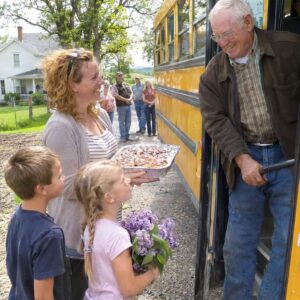
At the first farmhouse, a little girl named Lily stood holding a huge bunch of lilacs while her mother carried freshly baked cinnamon rolls. When Dad opened the bus door, Lily handed him the flowers and whispered, “These are for you, Mister Hal, because it’s your last day.” His eyes immediately filled with tears. As the bus continued north, every family along the route was waiting. Some held homemade signs, others brought coffee, food, and drawings. One little boy gave Dad a picture of a yellow bus with a driver wearing a brown jacket. An elderly widow even gave him a tiny wooden bus carved by her late husband decades earlier. By the twentieth stop, nearly every family had joined the procession behind us. Thirty vehicles followed Bus Number 7 along the gravel roads. Dad finally understood what I had arranged, but he didn’t say much. Then, without turning around, he quietly asked, “You did this, didn’t you?” I admitted that I had. He reminded me of my promise, and I assured him I had never told anyone about Neal’s debt. He drove silently for another mile. Then we reached the final stop, where my brother was standing beside a little girl in a pink coat. Neal looked thinner, older, and deeply ashamed. He stepped toward Dad holding a folded yellow piece of paper. It was a record of every month he had failed to repay the money. Then he handed Dad an envelope containing a cashier’s check for exactly $38,000. “I sold the lot,” he explained. “I couldn’t keep living with what I’d done to you.” Dad looked at his son, then at the check. “You paid me back today when you looked me in the eye,” he whispered.
But the most touching moment was still ahead. The little girl, Evie, stepped forward with a picture frame she had been holding against her chest all morning. Inside was a drawing of Bus Number 7, Dad behind the wheel, and a little girl sitting beside him. Above them, she had drawn a smiling woman with wings. Underneath, in colorful first-grade letters, were the words: “Mister Hal and me. And his wife watching.” Dad recognized the woman immediately. It was his wife, the woman he had lost five years earlier. He knelt down, holding the picture close, and cried. Neal wrapped his arms around him, and for the first time in two years, father and son held each other without shame or distance. That morning, Dad retired from driving. Neal kept his new job, and the two eventually drove to Arizona together to visit the Grand Canyon, the trip Dad and Mom had never taken. He kept $20,000 of the repayment for his own retirement and gave the remaining $18,000 to help Ruth, the elderly widow, save for her great-grandsons’ education. The yellow legal pad note remained in Dad’s kitchen drawer, but now it carried one final sentence in his careful handwriting: “Paid in full. May 23, 2025. At the end of the Van Wyks’ lane.” Beside it was a tiny drawing of a yellow bus. Because sometimes the greatest thing a person can give another isn’t money. It’s the chance to come home, make things right, and know that love was waiting all along.